Topics › Discipline
Microbiology — Step 1 practice questions
97 questions in this area, with an explanation for every answer choice.
Three samples below, free and without an account.
How this shows up on Step 1
Organism identification from a clinical picture, plus the mechanisms behind virulence and resistance. Antimicrobial questions sit at the boundary with pharmacology. Being able to move from presentation to organism to treatment is the pattern being tested.
Sample questions
Sample question 1
A 4-month-old unimmunized infant presents with two weeks of paroxysms of coughing followed by a gasping inspiratory sound and post-tussive vomiting. Between spells she appears well. Complete blood count shows a white cell count of 35,000/mm³ with 80% lymphocytes. Which of the following bacterial toxin mechanisms is responsible for the lymphocytosis?
Explanations
A. Cleavage of SNARE proteins in lymphocytes
SNARE cleavage is botulinum/tetanus toxin.
B. Inhibition of protein synthesis by ADP-ribosylating elongation factor 2
EF-2 ribosylation is diphtheria toxin and Pseudomonas exotoxin A.
C. ADP-ribosylation of Gi, disabling its inhibition of adenylate cyclase and impairing lymphocyte chemokine receptor signaling · correct
Whooping cough (Bordetella pertussis). Pertussis toxin ADP-ribosylates Gi, disinhibiting adenylate cyclase; among its effects is blockade of chemokine receptor signaling so lymphocytes cannot exit the bloodstream into lymphoid tissue — a striking absolute lymphocytosis. Treat with macrolides (which shorten contagiousness more than symptoms) and give prophylaxis to contacts.
D. Pore formation in the lymphocyte membrane
Pore-forming toxins (e.g., streptolysin O) lyse cells rather than trapping them in blood.
E. Superantigen-mediated polyclonal T-cell activation
Superantigens (TSST-1, strep exotoxin A) cause cytokine storm, not lymphocytosis.
Sample question 2
A researcher studies how bacteria acquire resistance genes rapidly across species. Which of the following mechanisms best explains this?
Explanations
A. Horizontal gene transfer through conjugation with plasmids, transformation of free DNA, and transduction by bacteriophage, which spreads resistance far faster than vertical inheritance · correct
Bacteria acquire resistance both by spontaneous MUTATION and, far more consequentially, by HORIZONTAL GENE TRANSFER: CONJUGATION transfers plasmids directly between cells through a pilus and can cross species boundaries, TRANSFORMATION takes up free environmental DNA, and TRANSDUCTION moves genes via bacteriophage. Because plasmids often carry MULTIPLE resistance genes together, a single transfer event can confer multidrug resistance instantly. Antibiotics do not create these mutations; they SELECT for organisms that already carry them.
B. Vertical inheritance spreads resistance faster than horizontal transfer
Horizontal transfer spreads resistance far more rapidly.
C. Spontaneous mutation is the only mechanism of resistance
Horizontal transfer is a major and often dominant mechanism.
D. Resistance genes cannot transfer between different bacterial species
Interspecies transfer is well documented and clinically important.
E. Antibiotics directly induce resistance mutations
Antibiotics select rather than induce resistance.
Sample question 3
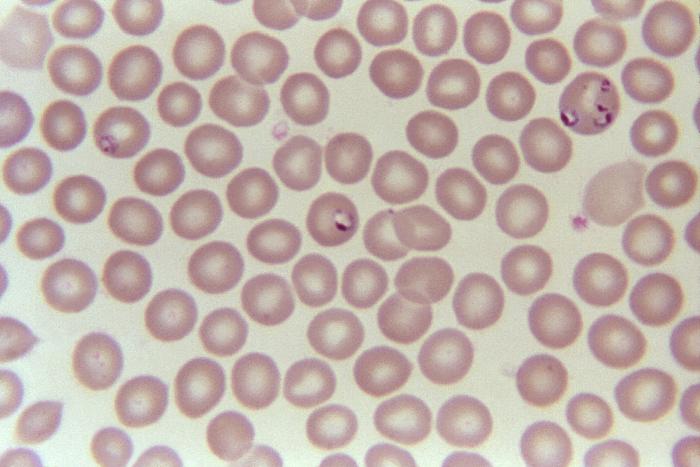
Blood smear photomicrograph.
A 68-year-old man from Nantucket presents in July with fever, fatigue, and hemolytic anemia several weeks after a tick bite. A blood smear is shown above, demonstrating ring-form parasites with multiple organisms occupying a single erythrocyte (upper right). Which of the following features on this smear, together with the clinical history, most supports this diagnosis over Plasmodium falciparum infection?
Explanations
A. The geographic/exposure history (Northeast U.S., tick bite) plus the presence of multiple parasites within a single red blood cell forming a tetrad-like grouping, without travel to a malaria-endemic region · correct
Babesia (transmitted by Ixodes ticks in the Northeastern/upper Midwestern U.S., often presenting in warmer months) can produce ring forms resembling Plasmodium falciparum, but a tick-exposure history without travel to a malaria-endemic area, combined with morphologic clues like multiple intraerythrocytic organisms forming tetrad ("Maltese cross") arrangements and the absence of malarial pigment, favors Babesia; PCR or reference lab confirmation is often still needed since morphology alone cannot always distinguish the two with certainty.
B. This smear finding cannot be distinguished from Plasmodium falciparum under any circumstances
While morphologic overlap is real and can be genuinely difficult (which is why confirmatory testing is often recommended), there ARE distinguishing clues (tetrad forms, extracellular forms, absence of pigment, exposure history) that can help favor one diagnosis over the other.
C. The patient's age alone, independent of any smear finding
Age alone does not distinguish these two infections; the exposure history and smear morphology are the relevant distinguishing features.
D. The presence of any ring forms at all, since this finding is unique to this organism and never occurs with Plasmodium
Ring forms are NOT unique to this organism — Plasmodium species (especially P. falciparum) classically also show ring-form trophozoites, which is exactly why the two are a classic diagnostic mimicry pair.
E. The presence of fever alone, independent of any smear finding
Fever alone is nonspecific and occurs in both infections; it does not distinguish between them.
Practice the rest
Build a quiz from this topic, or sit a full length exam under real conditions.
Start free